
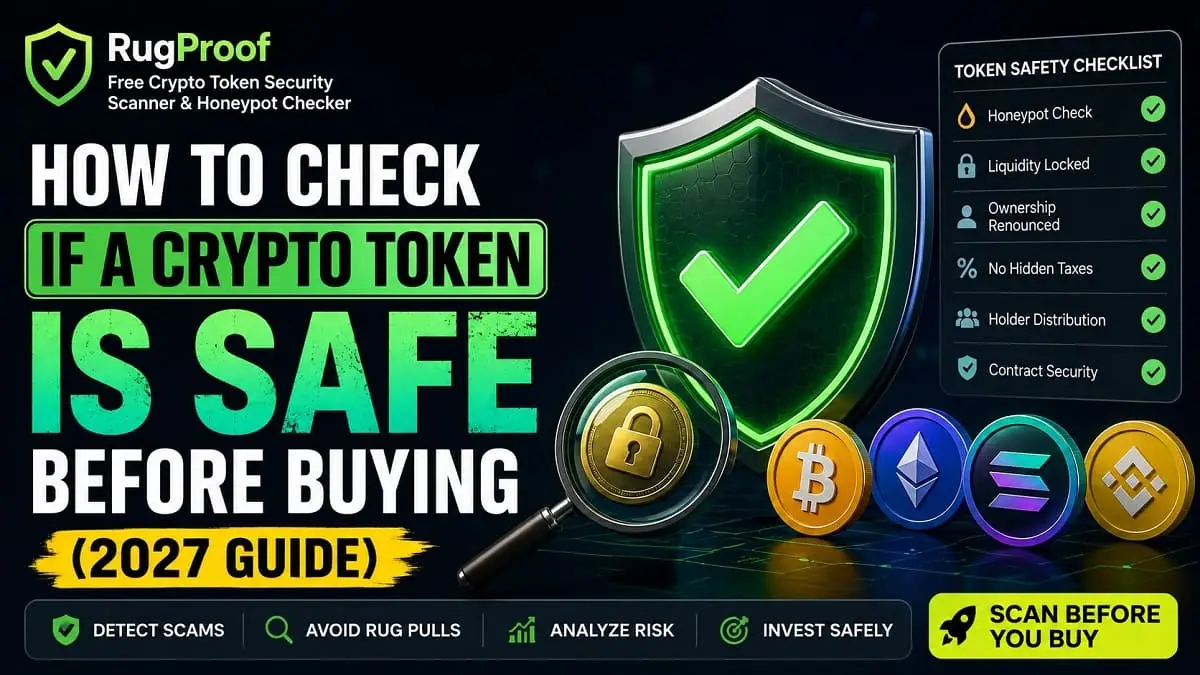
New tokens launch every single day, and most of them are not worth your money. Some are simply bad projects. Others are designed from the start to take your funds and disappear. Learning crypto token safety checks before you buy is one of the most valuable skills you can build as an investor, whether you're trading meme coins or evaluating a new DeFi project.
This guide walks you through exactly what to look for, why each check matters, and how to use free tools to verify a safe crypto token before you commit any money.
📑 Table of Contents
What Is Crypto Token Safety?
Crypto token safety refers to the process of evaluating a token's smart contract, liquidity, and ownership structure to determine whether it's likely to be a legitimate project or a scam. This isn't about predicting whether a token's price will go up. It's about identifying whether the underlying code and structure allow the creator to steal funds, block sales, or drain liquidity at will.
A token risk check typically looks at things like contract permissions, whether liquidity is locked, how concentrated the holder base is, and whether the token can actually be sold after it's bought. Tools like a Token Risk Scanner automate much of this analysis, pulling data directly from the blockchain rather than relying on marketing claims or social media hype.
Why It Matters
The crypto space has very little built-in protection for buyers. There's no bank to reverse a fraudulent transaction, no regulator to freeze a scammer's wallet in real time, and no guarantee that a project's team is who they claim to be. Once you send funds to buy a token, that transaction is final.
This is why pre-investment due diligence matters so much. A five-minute check can save you from losing your entire investment to a project that was never designed to succeed in the first place.
How Token Risk Checks Work
Most token safety tools work by reading the smart contract directly from the blockchain and, in more advanced cases, simulating a buy-and-sell transaction. A Honeypot Checker will attempt to simulate purchasing and then selling a token to see if the sell transaction actually succeeds. Some tokens are coded so buyers can purchase freely but can never sell, which is the classic definition of a honeypot.
Static analysis, on the other hand, examines the contract's code for suspicious functions without executing a live trade. Both approaches have value, and understanding the difference between live simulation and static analysis can help you interpret results more accurately.
Key Features of a Safe Token
While no check can guarantee a project's long-term success, certain technical features are strongly associated with lower risk:
- Renounced or limited ownership — the deployer can't unilaterally change core contract rules
- Locked or burned liquidity — funds backing the trading pair can't be pulled out instantly
- No unlimited mint function — the total supply can't be inflated arbitrarily
- Reasonable buy/sell taxes — extremely high taxes are a common scam tactic
- Distributed holder base — ownership isn't concentrated in a handful of wallets
Benefits of Checking Before You Buy
Running a token through a security scan before investing offers several practical advantages. It helps you avoid honeypots where you can buy but never sell, flags contracts where the owner retains dangerous permissions, and gives you visibility into whether liquidity could be pulled out from under you. It also builds a habit of research-first investing, which tends to produce better long-term outcomes than chasing hype.
Risks to Watch For
Some of the most common threats in the token ecosystem include:
- Rug pulls — developers withdraw liquidity or dump holdings, crashing the price to near zero
- Honeypots — contracts that allow buying but block selling
- Wash trading and fake volume — artificially inflated trading activity used to attract buyers
- Whale wallets — a small number of holders controlling enough supply to crash the market
- Token approval risks — granting unlimited spending approval to a malicious contract
- Wallet drainers and phishing scams — fake sites or messages designed to steal your private keys
- Fake presales and airdrops — schemes that collect funds or wallet permissions with no real product behind them
- Social engineering — scammers impersonating influencers, support staff, or project founders
Common Mistakes Beginners Make
Many losses in crypto come from avoidable errors rather than bad luck. Beginners often invest based purely on social media hype without checking the contract, assume a high market cap or trading volume automatically means safety, ignore ownership and liquidity lock status, or approve unlimited token spending without reviewing what permission they're granting. Skipping a quick Rug Pull Detection check before buying is one of the most common and costly mistakes.
Real-World Example
A typical rug pull follows a predictable pattern: a new token launches with an active marketing push across social media, price climbs quickly as buyers pile in, and then, once liquidity reaches a certain size, the deployer removes it from the trading pool in a single transaction. Buyers left holding the token can no longer sell, since there's no liquidity left to trade against. This exact pattern has repeated across thousands of tokens, and it's precisely what liquidity lock and ownership checks are designed to catch in advance.
Best Practices
- Always check the contract before buying, not after
- Verify liquidity lock or burn status independently
- Check holder distribution for concentration risk
- Never approve unlimited spending without understanding the request
- Treat unsolicited DMs about presales or airdrops with suspicion
- Use a Wallet Security check to confirm addresses before sending funds
- Cross-reference findings using more than one tool when a decision is high-stakes
Step-by-Step Guide
- Copy the token's contract address from the exchange, chart tool, or project's official channel — never trust an address from a random DM.
- Run it through a security scanner such as the RugProof token scanner to check ownership, liquidity, and contract permissions.
- Check honeypot status using a Honeypot Detector to confirm the token can actually be sold after purchase.
- Review holder distribution to see whether a small number of wallets control most of the supply.
- Confirm liquidity lock or burn status to check whether funds backing the trading pair can be withdrawn by the deployer.
- Check trading volume for red flags, since unusually high or erratic volume can indicate wash trading.
- Read the project's documentation and social presence critically, watching for vague promises or copied whitepapers.
- Make a decision based on the full picture, not on any single data point in isolation.
Frequently Asked Questions
1. Is it possible to be 100% certain a token is safe? No. No scanner can guarantee a project's future behavior or long-term success. Security checks reduce risk by identifying known scam patterns, but they can't predict every outcome.
2. What is a honeypot token? A honeypot is a token contract coded so that buyers can purchase it but are blocked from selling, often through hidden restrictions in the code.
3. Does a renounced contract always mean a token is safe? Not necessarily. Renouncing ownership removes certain risky permissions, but scams can still occur through other mechanisms, such as unlocked liquidity or hidden functions elsewhere in the code.
4. Why does liquidity lock status matter so much? If liquidity isn't locked or burned, the deployer can withdraw it at any time, which is the mechanism behind most classic rug pulls.
5. Are high market cap tokens automatically safer? No. Market cap can be manipulated through low float and wash trading, so it shouldn't be used as a standalone safety signal. 6. What should I do if a token asks for unlimited spending approval? Review the request carefully before approving, and consider revoking unnecessary approvals afterward using a wallet security tool. 7. Can free tools like RugProof replace my own research? They're a strong starting point that automates technical checks, but they should complement, not replace, your own due diligence on the team, product, and community. 8. How often should I re-check a token I already hold? It's worth re-checking after any major contract update, liquidity change, or unusual price movement, since risk conditions can shift over time.Final Thoughts
Checking crypto token safety before buying isn't optional in a market with this little built-in protection — it's a basic habit that separates careful investors from easy targets. Reviewing ownership, liquidity, holder distribution, and honeypot status takes only a few minutes but can prevent a total loss.
Tools such as RugProof can assist with this analysis by automating contract and liquidity checks, though they work best alongside your own research into a project's team, purpose, and community. Prioritize research first, invest second, and always verify before you trust.